
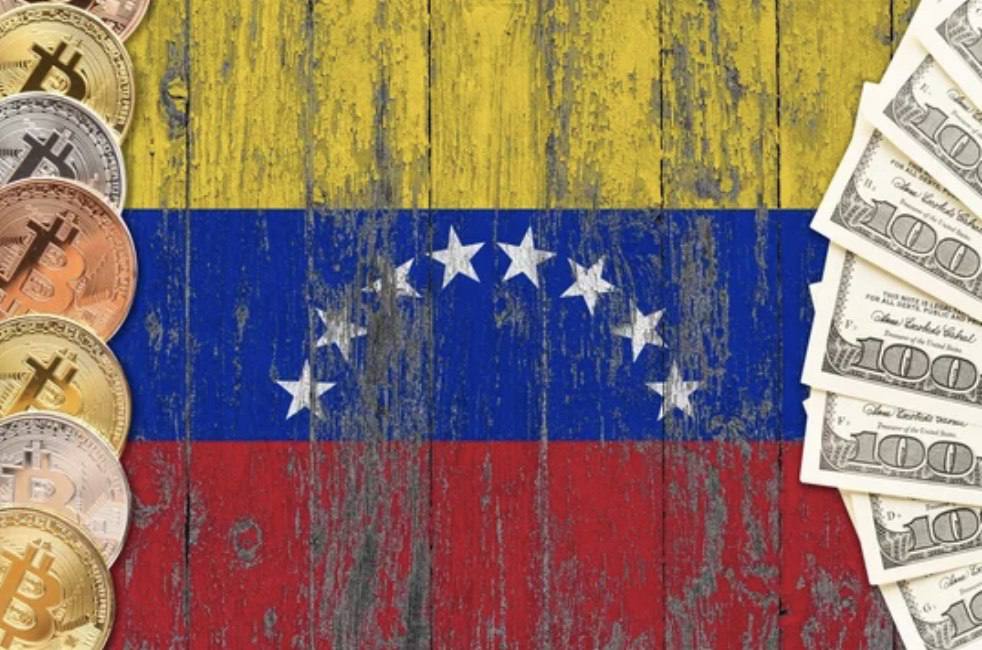
Overnight, Venezuela lost its grip on its own destiny.
The forced removal of President Maduro and his wife by U.S. forces was more than just a dark hour for this South American nation; it revealed a brutal reality. Under the weight of economic blockades, long-arm legal jurisdiction, and financial sanctions, the traditional defenses of national sovereignty are crumbling. This predicament may soon become a survival challenge that more nations—and individuals—must confront.
For Venezuela, a nation long plagued by hyperinflation and the shadow of sanctions, a response seems to have emerged early. Here, sovereign currency is being abandoned in favor of crypto assets as a lifeline for the people and an alternative financial tool for the state to bypass blockades.
Today, this survival tactic is rapidly evolving into a mainstream global financial trend. For the crypto industry, building a safe, reliable gateway for those outside the ecosystem is no longer just a technical hurdle. It is a historic opportunity to achieve mass adoption.
When Cash Is Worthless: Building the “Parallel Economy”
In Venezuela, crypto assets are not lottery tickets to wealth. They are tickets to board a lifeboat in an economic storm.
As a country devoured by hyperinflation, Venezuela is undergoing an unprecedented financial transformation. Data shows that the country ranks ninth globally in crypto usage per capita, with adoption rates climbing at a staggering pace year after year.
Consider a nation where over 30% of businesses and services have fully embraced cryptocurrency. From street vendors and grocery stores to salary payments and service settlements, crypto has permeated every corner of social operation.
The root of this migration is the total collapse of the Venezuelan fiat system. Excessive money printing, plummeting oil prices, international sanctions, and systemic corruption pushed inflation into an uncontrollable abyss. Despite official attempts to “re-denominate” the currency by lopping off zeros, the depreciation of the Bolivar consistently outpaced the speed of the printing presses.
The situation eventually reached the point of absurdity: citizens holding “millions” could not afford a roll of toilet paper or half a carton of eggs. Fiat lost its utility as money entirely, ending up folded into wallets, handbags, or woven into crafts sold on the street. For millions, holding Bolivars meant watching their life savings evaporate.
Amidst the ruins of traditional finance, the nation was forced to find a new way to survive. Today, a parallel economic system backed by cryptocurrency has quietly taken shape across Venezuela.
It is now a daily habit for many to convert Bolivar income into USDT or other cryptocurrencies immediately upon receipt to hedge against further devaluation. Furthermore, with millions of Venezuelans living abroad, crypto remittances have become a vital lifeline for families back home. Statistics show that of the roughly $5.4 billion in annual remittances, approximately 9% now flows through crypto channels. USDT is used not just for savings, but for daily commerce—accounting for roughly 10% of grocery payments.
As U.S. sanctions restricted the flow of USD and the government cracked down on black-market dollar trading, the Venezuelan government began allowing the private sector to use USDT for currency exchange in 2024 to keep the economy moving. Crypto has become a shield for protecting the fruits of labor and an essential for basic survival.
This penetration extends to the country’s economic arteries. Local businesses, banks, and oil-related entities are increasingly turning to stablecoins. It is an open secret that to circumvent sanctions, approximately 80% of Venezuela’s oil revenue has been settled in USDT. While the state-backed “Petro” was eventually discontinued, it is widely speculated that Venezuela has established a “crypto shadow settlement system” worth tens of billions of dollars. Though hard evidence is scarce, this system is effectively keeping the national economy on life support.
The Venezuelan case proves that cryptocurrency is a viable alternative when traditional systems fail. As global geopolitical risks escalate and financial infrastructure is increasingly weaponized, marginalized nations and individuals urgently need censorship-resistant, borderless financial tools.
The “Re-tooling” of Crypto: Geopolitics Reshaping the Narrative
In the past, the mainstream narrative of crypto focused on “get-rich-quick” myths and technical utopias. However, the global geopolitical crisis has unexpectedly pushed crypto’s utility to the forefront. It has become a “must-have” tool for evading financial blockades, maintaining wealth stability, and executing cross-border payments.
When a banking system is sanctioned or a regional network is cut off, crypto’s decentralized nature provides a “financial safe haven.” For nations, it is a strategic backup for trade; for individuals, it is a “Digital Noah’s Ark” against crumbling fiat credit.
Data reinforces this trend. Between July 2024 and June 2025, crypto transaction volumes reached $200 billion in Turkey (32% inflation), $93.9 billion in Argentina (31% inflation), and $44.6 billion in Venezuela (over 170% inflation).
Crypto has evolved from a fringe innovation to a core supplement to global financial infrastructure. The focus is shifting from price volatility to underlying utility as a vehicle for value transfer and storage. This “re-tooling” is supported by maturing infrastructure—moving away from high gas fees and congestion toward inclusive financial tools capable of handling high-frequency, commercial-grade transactions.
Creating a “Safe Harbor”: Exchanges as the Future Financial Gateway
Venezuela’s parallel economy shows that the fundamental question is now: How can ordinary users safely and easily access this new system?
The answer lies with Centralized Exchanges (CEXs). In volatile environments, the core user demand is security. For these users, crypto isn’t just for trading; it’s for life savings. To achieve mainstream acceptance, platforms must be accessible and absolutely trustworthy.
In unstable regions, exchanges have become the primary channel for asset management. In Venezuela, over 38% of crypto activity occurs on P2P platforms. Exchanges there serve as hubs for secure storage, exchange, and even exchange-rate benchmarks.
This shift has redefined the logic of competition. It is no longer about “involuted” battles over fees or listing speeds; it is about who can become the “Future Financial Gateway” that empowers users to safely participate in wealth preservation.
As an established platform with eight years of experience, CoinW has built a multi-layered ecosystem to serve as this gateway:
- CoinW: A one-stop platform offering spot, futures, ETFs, and wealth management, backed by industry-leading liquidity and risk control.
- GemW: Focuses on “early discovery and fast participation,” lowering the barrier to entry for trending on-chain assets with wallet-free registration and zero gas fees.
- DeriW: Allows users to explore decentralized derivatives with the smooth experience of a centralized platform.
- PropW: Focuses on trader education and evaluation, providing professional tools and simulated capital to help traders grow.
Security remains the bedrock. CoinW follows a “compliance-first” strategy, covering multiple jurisdictions globally. Its “Defense-in-Depth” security system includes real-time risk engines, zero-trust architecture (Palo Alto Prisma), and partnerships with top auditors like CertiK. These efforts have earned CoinW a consistent AAA security rating from CER.live.
With over 20 million users and $200 billion in annual trading volume, CoinW’s growth reflects the transition of crypto from the fringes to the mainstream.
Conclusion
The eye of a storm often nurtures the seeds of a new order. From buying bread with crypto to settling oil trades on the blockchain, the Venezuelan crisis reflects a bottom-up global financial restructuring. It signals a future where crypto becomes the indispensable “Digital Ark” when traditional dams fail.
This ark requires safe harbors and steady captains. The industry’s center of gravity is shifting from price-chasing to building trusted gateways. CoinW’s mission is to be that gateway—filtering out market noise to protect a user’s long-term financial journey.
As the world begins to take the utility of crypto seriously, the real race is about who can deliver that value safely into the hands of ordinary people. This is not just about building technology; it is about building trust. History favors those who start building early.
Risk Warning: The content of this article is for general information purposes only and does not constitute investment advice. Crypto assets carry high risks; please ensure you fully understand these risks before participating.
Source: PANews https://www.panewslab.com/en/articles/f40a099c-ec29-4bf0-a108-dbf9dd0ce47d